

Third-Party Risk: When Your Vendor’s Breach Becomes Yours
You can do everything right, with strong passwords, multi-factor authentication and trained staff, and still suffer a breach because a company you have never dealt with directly was compromised. As organisations lean ever harder on shared suppliers and platforms, third-party risk has become one of the defining security challenges of the year.
The short version: many organisations depend on the same vendors, so a single supplier compromise can expose every customer at once. You can outsource the service, but the reputational and regulatory consequences still land on you. Managing the risk means knowing who holds your data, limiting what they can access, and preparing for their breach as if it were your own.
Why one vendor is such a tempting target
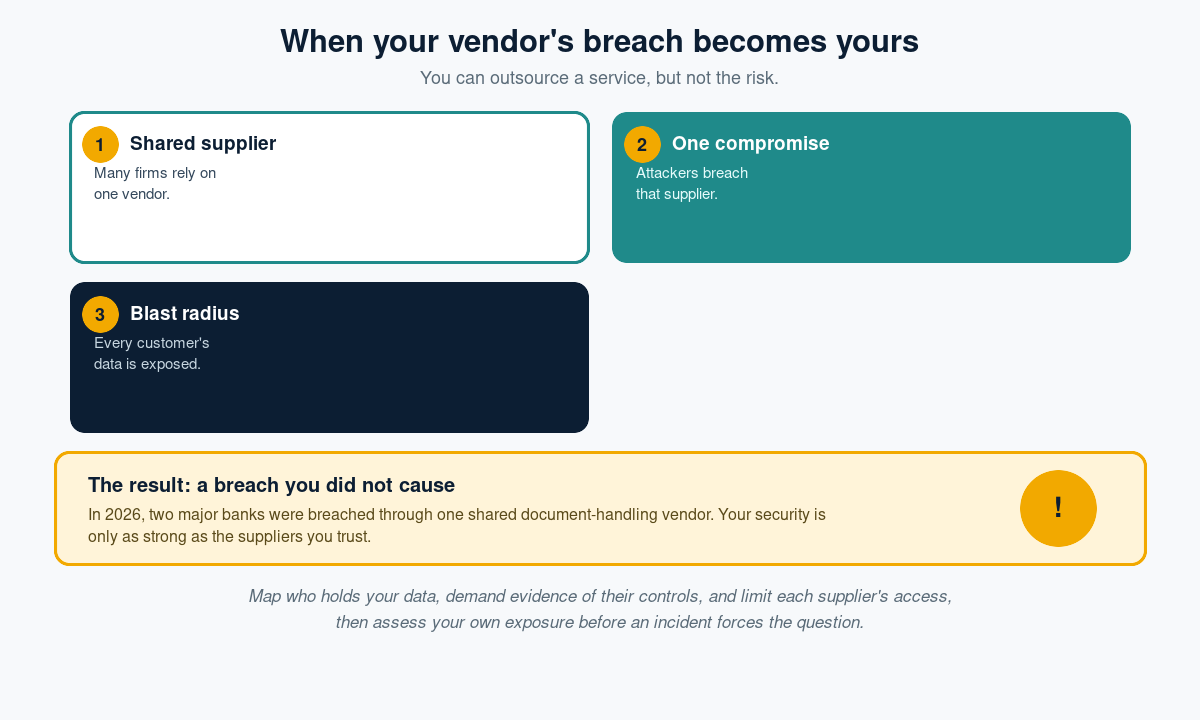
For an attacker, a widely used supplier is a force multiplier. Breaking into one shared platform can yield the data of dozens or hundreds of downstream customers in a single effort. In 2026, two major banks disclosed breaches that both traced back to the same shared document-handling vendor, a vivid reminder that your security posture is only as strong as the suppliers you trust with your data.
The uncomfortable truth about outsourcing
Outsourcing a function does not outsource the accountability. When a supplier loses your customers’ data, it is your name in the headlines, your customers who are affected, and often your regulatory obligation to notify. Treating vendor security as “their problem” is no longer tenable.
How to manage third-party risk
Know who holds your data
Maintain a clear inventory of which suppliers process or store your data and what access each one has. You cannot protect what you have not mapped.
Demand evidence, not promises
Ask suppliers for proof of their controls, such as certifications, audit results, MFA enforcement and breach-notification commitments, and build security expectations into contracts.
Limit access and segment
Give each vendor the minimum access they need and no more, so a supplier compromise cannot reach your wider environment.
Plan and assess
Rehearse how you would respond to a key supplier’s breach, and gauge your wider exposure with a quick cyber readiness check. Keep your own front door shut too, and give staff an easy way to report a suspicious email, since attackers often pivot from one victim to the next.
The bottom line
Supply-chain and third-party breaches are a reminder that security extends well beyond your own perimeter. Map your suppliers, hold them to real standards, limit their access, and plan for their failure, so a partner’s bad day does not become your crisis.
Phishing Tackle offers the tools businesses need to strengthen their human risk strategies, with multi-platform testing, real-time behavioural insights, and actionable data to keep your organisation ahead of modern cyber threats.
Contact us today to learn how Phishing Tackle can help safeguard your organisation from the growing array of cyber risks.
