
Insider Risk: The Threat That Walks in Through the Front Door
Security spending is overwhelmingly aimed outward, at keeping attackers on the far side of the wall. Yet a large share of data loss never involves an outsider breaking in at all. It comes from people who are already inside and already trusted, through honest mistakes far more often than malice. Insider risk is uncomfortable to talk about, because it is not about faceless criminals but about colleagues, and that is exactly why it is so often under-managed.
The reassuring part is that the same controls address both the accidental and the deliberate versions.
Boiled down: insider risk comes in three flavours, the accidental leak, the negligent shortcut, and the malicious insider. Most incidents are mistakes rather than sabotage, but the data is just as gone either way. Managing it means limiting what people can reach, watching for unusual data movement, and building a culture where errors are reported early rather than hidden.
The three faces of insider risk
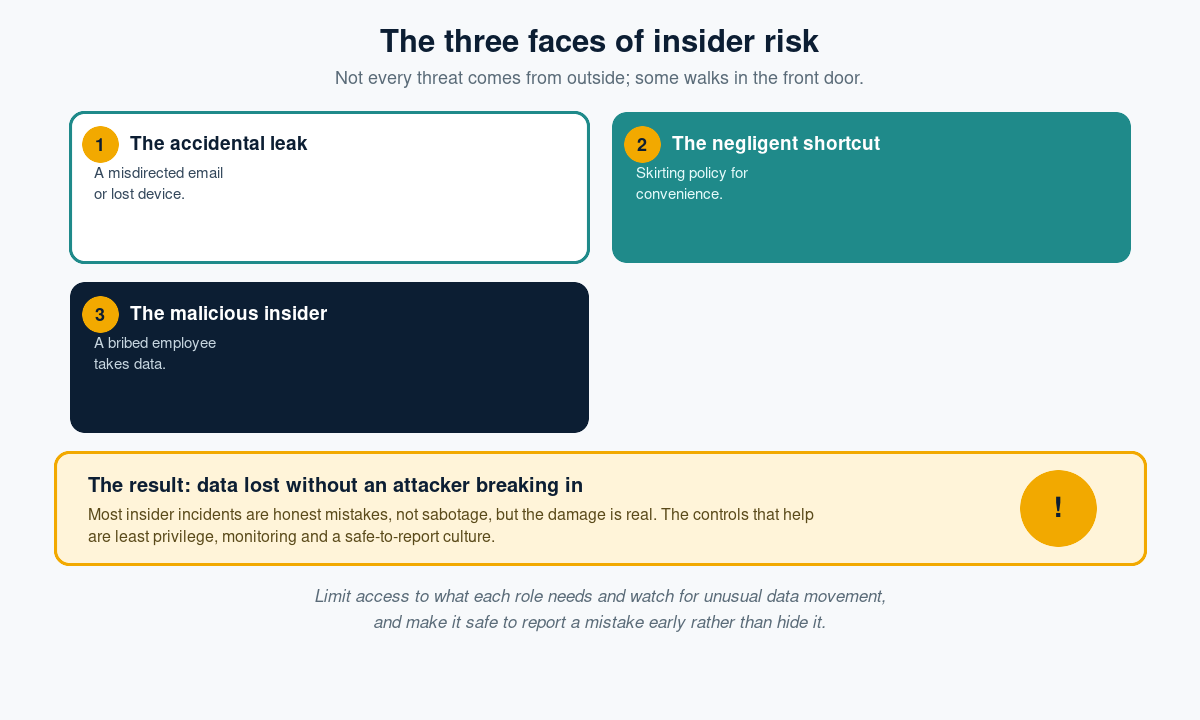
The accidental leak
By far the most common. An email sent to the wrong recipient, a cloud folder shared too widely, a spreadsheet with hidden data attached, a laptop or phone left on a train. No ill intent, but sensitive data exposed all the same.
The negligent shortcut
People under pressure cut corners: reusing passwords, moving company data to a personal account to work from home, or switching off a control that gets in the way. Each shortcut opens a gap that an attacker, or plain bad luck, can exploit.
The malicious insider
The rarest but most deliberate. A disgruntled employee, someone leaving for a competitor, or a person bribed or coerced, who takes data or abuses access on purpose. Uncommon, but capable of serious and targeted harm.
Why it is so hard to stop
Insiders start with legitimate access, so their activity looks normal by default. There is no exploit to block and no malware to detect; a person downloading files they are allowed to download does not trip a wire. And because the subject is sensitive, organisations are often reluctant to monitor staff or to treat mistakes as reportable events, which leaves the risk both real and unmeasured.
How to manage insider risk
Least privilege, seriously applied
Give every person and system access only to what the role genuinely needs, and review it regularly, especially when people change roles or leave. The less each account can reach, the smaller any single mistake or misuse becomes.
Watch how data moves
Use data loss prevention and monitoring to flag unusual movement: large downloads, uploads to personal storage, sensitive files leaving the environment, or bulk access out of pattern. The aim is to notice the out-of-character, not to surveil the everyday.
Reduce the chance of honest error
Make the safe path the easy one. Warnings on external email, controls on oversharing, encrypted and tracked devices, and clear guidance all cut accidental leaks. A quick cyber readiness check can reveal where those guardrails are missing.
Build a culture that surfaces mistakes
The single most valuable thing you can do is make it safe to say “I think I sent that to the wrong person” the moment it happens. Speed of reporting decides whether an error is contained or compounded, so treat honest mistakes as learning rather than grounds for punishment, and give people the same easy route to report a mistake or a suspicious email that they would use for an external threat. Reinforce good habits with realistic simulations and ongoing awareness.
The bottom line
Not every threat comes through the firewall. Some are already sitting at a desk, usually meaning no harm. Because insiders act with legitimate access, you cannot block your way to safety; you have to limit what people can reach, watch for the unusual, make the careful path convenient, and build enough trust that people flag their own errors early. Do that, and most insider incidents shrink from breaches into near-misses quietly put right.
Phishing Tackle offers the tools businesses need to strengthen their human risk strategies, with multi-platform testing, real-time behavioural insights, and actionable data to keep your organisation ahead of modern cyber threats.
Contact us today to learn how Phishing Tackle can help safeguard your organisation from the growing array of cyber risks.
