
Cloud Identity Attacks: Why the Login Is the New Perimeter
For decades, security meant defending a boundary. Firewalls marked the edge of the network, and the job was to keep intruders outside it. That boundary has quietly dissolved. Work now happens across dozens of cloud services reached from any device, all tied together by single sign-on, and the thing that unlocks them is not a network connection but an identity. In the cloud era, the login is the new perimeter, and it is where attackers now aim.
Microsoft Entra, Okta and their equivalents have become the front door to everything, which makes the identity platform both the most valuable target and the most important thing to defend.
In plain terms: single sign-on links your email, files and dozens of SaaS applications to one identity. Attackers no longer need to breach a network; they phish or relay a credential and inherit whatever that identity can reach. Because one compromised login can open so much, protecting the identity, with phishing-resistant MFA, conditional access and least privilege, matters more than any firewall.
Why identity became the target
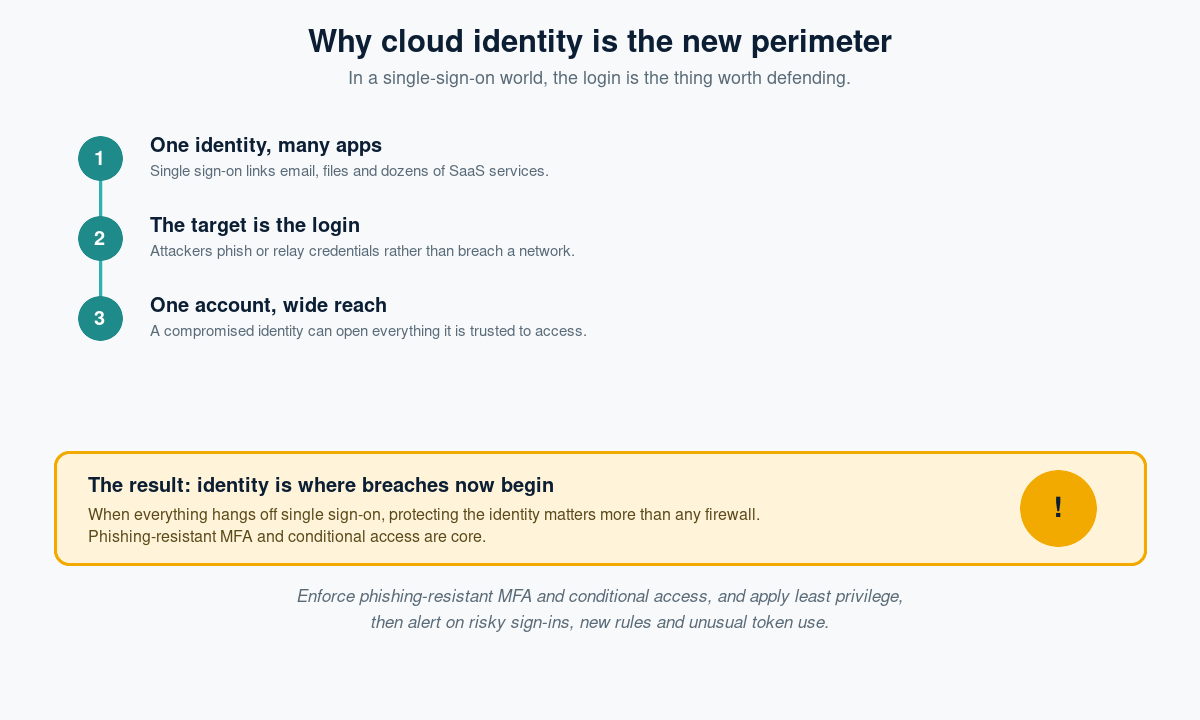
Two shifts drove the change. First, data and applications moved to the cloud, so there is often no internal network to break into; the valuable things sit behind a login reachable from the public internet. Second, single sign-on tied those applications together for convenience, which means one set of credentials can unlock email, file storage, finance systems and customer data all at once. Attackers followed the value. Rather than hunting for a vulnerability to exploit, they simply try to become a legitimate user, because once they are, everything that user is trusted with is open to them.
How the attacks work
The methods are the ones seen throughout modern phishing: stealing passwords, adversary-in-the-middle kits that relay credentials and capture session tokens, MFA fatigue, malicious OAuth consent, and infostealers that lift tokens straight from a browser. What they share is a target: the identity, not the perimeter. A stolen session token is especially prized, because it can let an attacker resume a logged-in session without a password, and sometimes without triggering MFA at all.
Securing cloud identity
Phishing-resistant MFA first
Ordinary MFA helps, but passkeys and FIDO2 security keys are the gold standard because they cannot be phished or relayed through a fake page. Prioritise administrators, finance and other high-value accounts, then widen coverage across the workforce.
Conditional access as the gatekeeper
Use conditional access to require managed, compliant devices and sensible location or risk conditions, so a stolen credential alone is not enough to sign in. Policies that weigh risk in real time can challenge or block a suspicious login before it succeeds.
Least privilege and tidy identities
Grant each identity only the access it needs, separate everyday accounts from administrative ones, and review permissions and connected apps regularly. The less any single identity can reach, the less a compromise is worth.
Watch identity like a network
Alert on the tell-tale signs of account takeover: impossible travel, sign-ins from unusual locations or devices, new mailbox rules, unusual token use, and risky OAuth grants. Be ready to revoke sessions and tokens quickly, not just reset passwords. And keep closing the front door with training and an easy way to report suspicious emails, since phishing is still how most credentials are lost. Run realistic simulations to keep that instinct sharp.
The bottom line
The perimeter did not disappear; it moved, from the edge of the network to the identity itself. That is why so many modern breaches begin not with a broken lock but with a legitimate login in the wrong hands. Protecting cloud identity with phishing-resistant MFA, conditional access, least privilege and sharp monitoring is the single most valuable thing most organisations can do, because in a single-sign-on world, whoever controls the identity controls everything behind it.
Phishing Tackle offers the tools businesses need to strengthen their human risk strategies, with multi-platform testing, real-time behavioural insights, and actionable data to keep your organisation ahead of modern cyber threats.
Contact us today to learn how Phishing Tackle can help safeguard your organisation from the growing array of cyber risks.
