
Building a Reporting Culture: Turning Employees Into a Human Sensor Network
Most cyber security advice about staff focuses on stopping them clicking. That matters, but it quietly misses a bigger opportunity. Even the best-trained workforce will occasionally be fooled, because attackers only need to be convincing once. What turns an unlucky click into a contained incident, rather than a breach, is how quickly someone tells you about it. A workforce that reports is worth far more than a workforce that merely avoids.
Every phishing email that reaches one inbox has usually reached many. The first person to report it hands you the chance to protect everyone else.
The heart of it: when reporting a suspicious message is fast, easy and encouraged, your employees become a live sensor network. One report lets security pull the same threat from every other inbox and warn the whole organisation before more people fall for it. The barriers to that are cultural as much as technical, so the fix is to make reporting effortless and to reward it, never to punish honest mistakes.
Why reporting beats blocking alone
No filter catches everything, and the cleverest attacks, such as reply-chain hijacking and well-crafted spear-phishing, are designed specifically to get past technology. When one does, the question is how long it sits in inboxes doing damage. If even a single recipient reports it quickly, your security team can find every copy, remove them, block the sender and infrastructure, and alert staff. A campaign that might have claimed a dozen victims is stopped after one. That is the difference a reporting culture makes: it shortens the window between arrival and containment from days to minutes.
How the human sensor network works
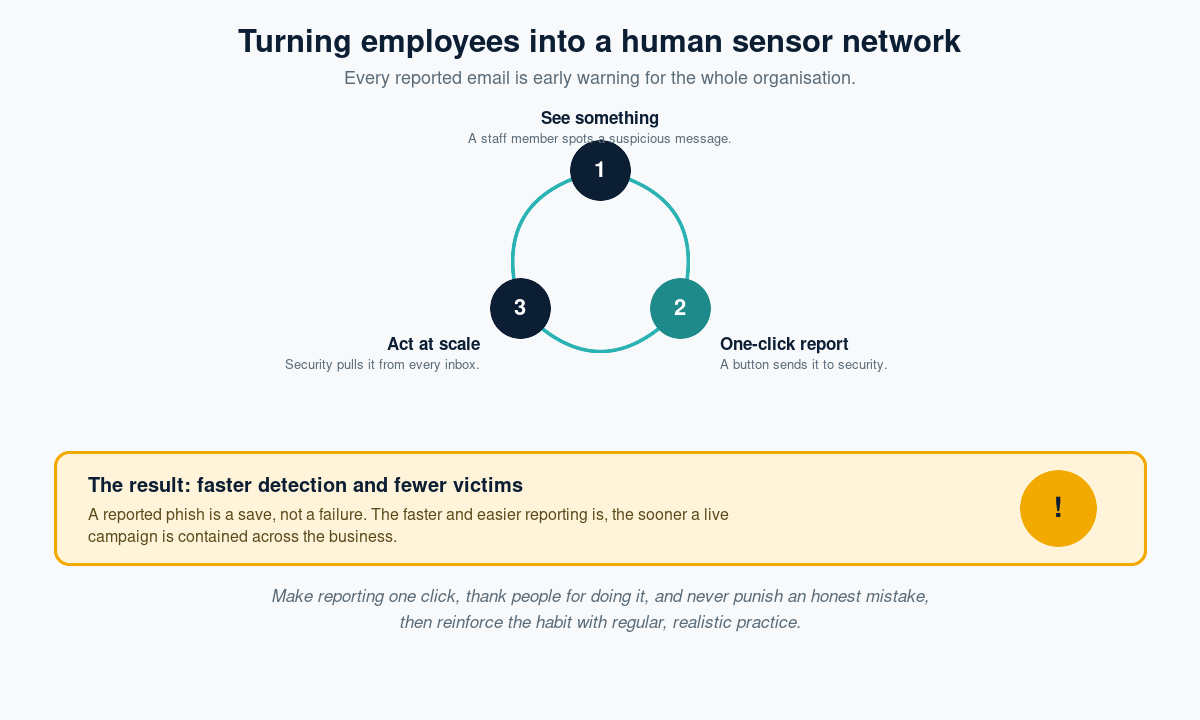
The idea is straightforward. A member of staff notices something that feels off. With a single click they send it to the security team, no agonising over whether it is really malicious and no forwarding faff. Security triages it, and if it is a live threat they act at scale: sweeping it from every mailbox, blocking the indicators, and warning the wider business. Each report also teaches the organisation something about what is currently being aimed at it. Thousands of employees watching their own inboxes will always see more than any single tool.
The barriers that stop people reporting
If reporting is so valuable, why is it often so rare? Usually because of friction and fear. Friction, when reporting means digging out an address, writing an explanation, or fiddling with attachments, so people simply delete the message instead. Fear, when staff worry they will look foolish for flagging something harmless, or, worse, that they will be blamed if they realise they already clicked. A culture that treats a mistaken report as a nuisance, or a click as a disciplinary matter, trains people into silence at exactly the moment speed matters most.
How to build a reporting culture
Make it one click
Put a reporting button right where people read their email, so flagging a message takes a second and needs no judgement about severity. The easier it is, the more you will hear, and volume is what makes early warning work. A clear route to report a suspicious email removes the main excuse not to.
Thank people, and close the loop
Acknowledge every report, and tell people what happened when they help. A quick “thanks, that was a real one and we have removed it from 40 inboxes” turns a small action into a visible win and encourages the next report.
Never punish an honest mistake
Treat a click, or a false alarm, as a chance to learn rather than a failure to punish. The moment reporting feels risky, it stops. Psychological safety is the foundation the whole system rests on.
Practise until it is a habit
Reinforce the behaviour with realistic simulations that reward reporting, not just avoidance, and measure how many people report as well as how many click. If you would rather not run all this in-house, a managed service can keep the programme consistent and the momentum up.
The bottom line
Technology will always miss some attacks, and people will occasionally be caught out. A strong reporting culture is what turns those inevitabilities into non-events, because the faster a threat is flagged, the fewer people it reaches. Make reporting a single click, thank the people who do it, never punish an honest mistake, and keep the habit sharp with practice. Do that, and your workforce becomes the fastest, widest-reaching phishing detector you have.
Phishing Tackle offers the tools businesses need to strengthen their human risk strategies, with multi-platform testing, real-time behavioural insights, and actionable data to keep your organisation ahead of modern cyber threats.
Contact us today to learn how Phishing Tackle can help safeguard your organisation from the growing array of cyber risks.
